
How regulated industries can define the contract between AI systems and human judgment in domains where errors have regulatory and brand consequences.
The Problem with Enterprise Regulated AI
The core user problem for enterprise AI is this:
With Consumer AI, the wrong answer annoys the user. However, with Enterprise Regulated AI, the wrong answer results in regulatory violation and significant brand harm.
The difference between the two isn’t technical. It’s an architectural and incentive difference.
As Doxim builds AI for regulated communications, we’re designing systems that must:
- Make irreversible actions on behalf of regulated institutions
- Operate with zero-error tolerance in ambiguous domains
- Navigate strictly under compliant and regulatory requirements
- Maintain audit trails for compliance
- Know their own limitations (which is our toughest AI problem)
As the Doxim CCM AI Lab goes about building AI for regulated communications, our core challenge is: how do you architect and implement AI systems that maximize autonomy while maintaining institutional control?
It’s a boundary question, not an AI question.
The AI Boundary Framework
The first principle for AI products in the enterprise, as opposed to consumers, is to define clear boundaries. AI systems in regulated industries need architectural constraints, not just better models.
Here’s the framework Doxim uses to architect autonomous AI that can hand off to humans and know its limitations:
The Four-Factor Autonomy Model
Doxim AI in a production environment will proceed autonomously only when ALL four architectural constraints are satisfied:
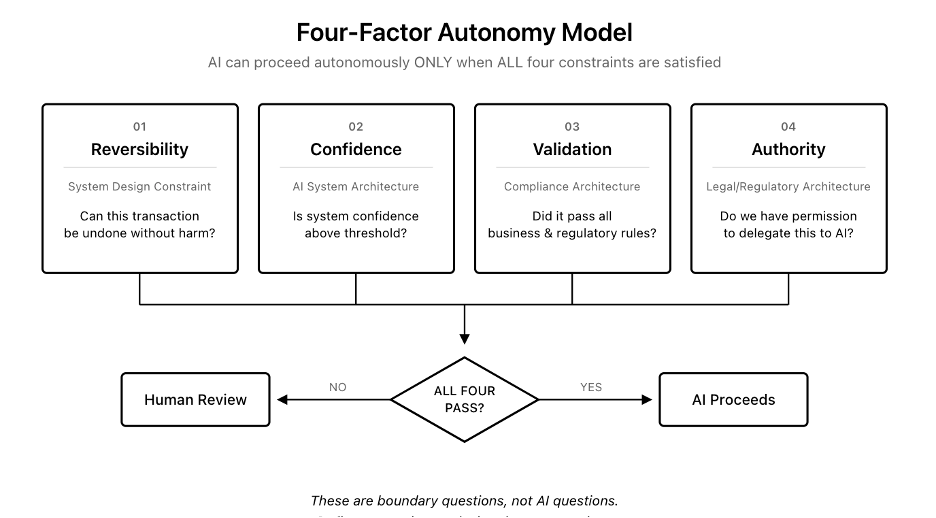
Product Architecture Pattern: Separation of Concerns
The key operating principle for AI elements in an enterprise with regulatory oversight: Don’t make AI responsible for knowing its boundaries.

Why This Matters:
- AI models will change (GPT-5.1 to GPT-6 to future models)
- Regulations will change (new states, new rules)
- Business rules will change (thresholds, processes)
The Pre-Compliance Architecture
A Doxim key insight: Compliance should be invisible to both the customer and AI.
If you’re at a regulated institution such as banking, insurance, healthcare, or wealth management, wrestling with AI autonomy decisions, you’re solving problems that don’t yet have established patterns.
The product architecture decisions you make today, how you design autonomy boundaries, how you architect confidence systems, and how you separate AI from compliance will determine whether your AI POCs and Products scale sustainably or become maintenance nightmares.
At Doxim’s CCM AI Lab, we are building this across multiple regulated verticals. We’ve made the architectural mistakes and learned the hard lessons. The framework described in this article emerged from production and will enable our customers to modernize their CCM Stack.
Looking for more information on AI in CCM? Reach out to us today and book a personalized demo!