
Modern utility billing strengthens the full meter-to-cash lifecycle with easy-to-read bills, flexible payment options, and healthy cash flow.
For years, utility billing and payment experiences have seen limited innovation. High upgrade costs, complex legacy systems, and shifting customer expectations have slowed modernization efforts, leaving many utilities with billing and payment processes that no longer match how customers expect to receive, understand, and pay their bills.
Focusing on what customers value most can help utilities simplify modern utility billing efforts and prioritize investments that deliver the greatest impact across the entire bill-to-payment journey
What Do Customers Really Want from Their Utility Bill and Payment Experience?
Let’s start with the obvious.
The utility bill’s primary function is to communicate usage charges. But if those charges are hard to find within a few seconds, the customer will be more likely to contact customer service.
Those charges also need to be easy to understand. Eliminating confusion around pricing and calculations is one of the most effective ways to reduce call center volumes.
Improving the payment experience should be the next priority. Unclear payment journeys or limited options introduce friction in the customer experience and delay revenue for you.
Modern utility billing combines bill presentment with flexible payment options, improving customer satisfaction and your ROI, making a payment reinvention a worthwhile investment.
Modern Utility Billing is Always the Answer
Customers want convenient payment options and clarity about their charges from the start of the meter-to-cash lifecycle. Operations teams are seeking easier, more efficient ways to create, execute, and deliver accurate and timely communications.
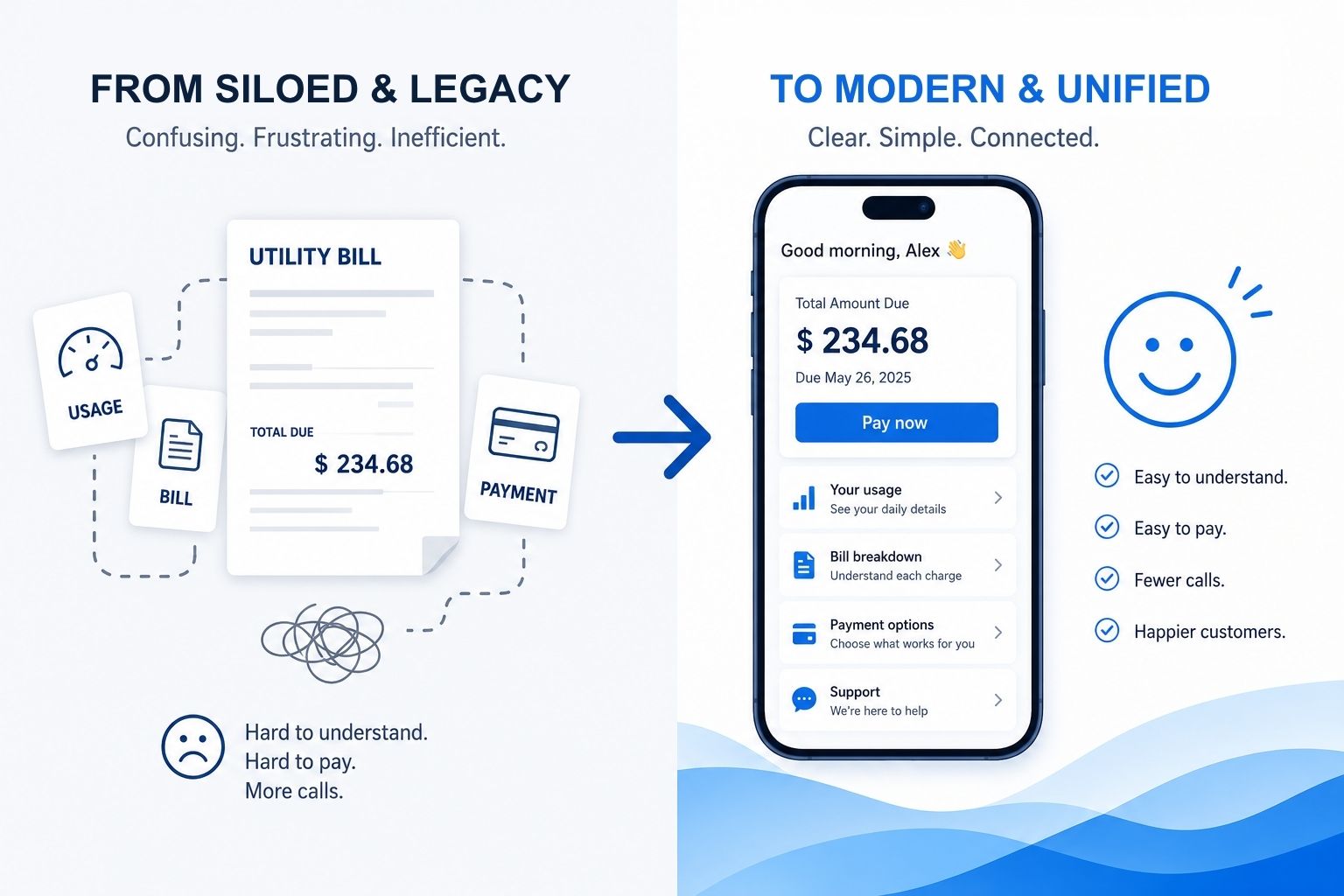
Many utilities still work with systems that aren’t built for today’s expectations. Customer information is often stored in silos, payment reconciliation takes too long, and outdated bill formats create confusion.
By replacing outdated systems and manual processes with one-stop, modern solutions, utilities can simplify their operations to deliver an easier way to manage payments.
Research from The National Regulatory Research Institute (NRRI) notes that billing systems, customer communications, and complaint management are closely connected. It identifies opportunities to reduce customer complaints through better billing and customer care practices.
Modernizing the billing process helps reduce that friction. Automated billing, multi-channel communication, and payment options, as well as better account management, make it easier for customers to stay informed and pay on time, while helping utilities improve operational efficiency and ROI.
What is Utility Bill Presentment and Payment?
Like electronic bill presentment and payment (EBPP), utility bill presentment and payment (UBPP) refers to the bill payment steps that a utility provides its customers.
It encompasses charges, account management steps, and convenient payment methods. Instead of treating billing and payments as separate processes, utilities can provide customers with a single experience from bill delivery to payment receipt.
What is the Difference between UBPP and EBPP?
UBPP and EBPP in utilities are closely related, but the primary focus of EBPP is the ability to make payments online. While the terms are sometimes used interchangeably, many utilities use UBPP to describe a more complete billing and payment experience that gives customers greater flexibility.
UBPP solutions go far beyond sending a bill. They deliver a complete digital experience that helps customers view, pay, and manage their accounts with ease.
Through a secure online portal, customers can manage their accounts anytime, anywhere:
-
Review their bills: Access current and past bills, usage history, and account activity in a clear and user-friendly format.
-
Update their account profile: From delivery preferences to automatic bill payments, customers can choose how they want to manage their utility bills.
-
Set notifications: Customers can take account management to the next level by toggling reminders for upcoming charges, account notifications, outages, and more.
The pandemic accelerated digital transformation across the utility industry, prompting many organizations to modernize their billing and payment systems. Understanding what modern utility billing and payment include is the first step toward strategic transformation.
What is Modern Utility Billing and Presentment?
Modern utility billing and payments help utilities manage the entire meter-to-cash lifecycle through a centralized, automated platform, covering all aspects of the process, including:
- Meter data collection and bill calculation
- Bill presentment
- Flexible payment processing
- Omnichannel communications
- Account self-service
- Reporting and analytics
Through advanced automation, modern billing and payment platforms help improve bill accuracy, reduce manual work, and provide greater visibility into billing operations between internal teams.
Rather than replacing core systems at once, many utilities are modernizing billing and payment capabilities incrementally. According to Utility Dive, new billing platforms can integrate with existing utility infrastructure. It gives organizations a way to improve billing operations while continuing to use the systems they’ve already invested in.
How Can Utilities Improve Payment Processing?
Payment processing is an important part of the utility meter-to-cash lifecycle. Modern utility billing improves payment processing by ensuring billing and payment workflows are properly synchronized through automation.
When payment processing is integrated with reporting and reconciliation, utilities gain greater visibility into payment activity, making it easier to monitor transactions and support customer service teams with accurate account information.
From the customer’s point of view, it offers flexibility by supporting multiple payment methods, including online and mobile payments, and even recurring bill payments. It’s an attractive option for customers hoping to turn everyday expenses into automatic credit rewards.
Research from the Federal Reserve has consistently shown that consumers continue to adopt digital payment methods while still expecting choice. Utilities that aim to improve the utility payment experience through flexible options are better positioned to meet those expectations rather than forcing customers into a single way of paying.
Working with a communications provider that delivers a unified omnichannel bill payment processing solution can help you meet your customers’ evolving expectations without adding complexity to your workflows.
Why is Payment Reconciliation Important for Utilities?
In addition to efficient payment processing, utilities also need to accurately reconcile payments to ensure customer accounts, financial records, and reporting remain up to date.
Payment reconciliation matches incoming payments with customer accounts and billing records. Manual reconciliation can be time-consuming, especially when payments come from multiple channels.
Modern utility billing solutions help automate this process by reducing manual data entry, identifying exceptions more quickly, and providing greater visibility into payment activity. It creates better reporting. Finance teams have access to more accurate payment data, while customer service representatives can quickly verify account information when assisting customers.
This reduces delays, improves accuracy, and gives utilities a clearer picture of payment performance.
How Can Modern Billing Reduce Days to Pay?
Payment experiences that feel effortless and meet modern standards mean customers are more likely to pay on time and in full. Here’s what modern payments should look like:
- Bills are available in the customer’s preferred channel.
- Multiple payment channels improve convenience and remove immediate barriers.
- Automated payment reminders and self-service account management give the customer greater control, transparency, and access to their bills.
- Channel preferences and notifications can be easily toggled within the customer’s account portal.
Reducing days to pay immediately improves cash flow by reducing outstanding balances and adding a layer of predictability in the revenue cycle, all while improving customer experience.
Interested in learning how our all-in-one billing and payments solution can improve engagement?
What Payment Channels Should Utilities Offer Customers?
Before incorporating the latest payment channel, utilities should look to billing and payment solutions that can easily integrate new payment channels as expectations evolve. The best solutions are flexible enough to meet the diverse needs and preferences of your service territory.
Many utilities now support a combination of traditional and digital payment options, including:
- Online customer payment portals
- Mobile-friendly payment experiences
- Automatic payments through a customer’s financial institution
- In-person payments at participating retailers
How Does Modern Utility Billing Improve Utility Payments?
When the path from bill presentment to payment is simple, customers have a better experience, and utilities benefit from faster collections and healthier cash flow.
Here’s an overview of what to look for in a modern utility bill and payment solution:
Accurate billing and billing automation
Modern platforms should create efficiency while mitigating errors in processing and creation.
A simple customer experience
Customers want convenient ways to view and pay their bills. Look for a provider that supports digital and print delivery, mobile payments, online portals, auto pay, and other payment channels so customers can choose what works best for them.
Automatic payment processing
Payments should move through the system with little manual effort. Look for automation that handles payment posting, file transfers, and reconciliation to reduce errors and save staff time.
Easy integration with existing systems
Your payment platform should work with your CIS, ERP, and other core systems. Real-time integration helps keep customer and financial records up-to-date without manual data entry.
Strong security and compliance
Payment data must be protected. Look for built-in security features such as encryption, tokenization, fraud controls, and compliance with industry standards like PCI DSS, NACHA, and SOC 2.
Clear reporting and visibility
Finance and operations teams need an accurate view of payment activity. Real-time reporting and dashboards make it easier to monitor transactions, track performance, and resolve issues quickly.
Better bill design
Bills should be easy to read, accessible across print and digital channels, and organized so customers can quickly understand their usage, charges, due dates, and payment options. Incorporating unique elements such as interactive video can further enhance information retention.
A modern billing payment solution should make life easier for both customers and utility staff. By choosing a platform that does most of the work for you, while keeping data secure, utilities can improve day-to-day operations and create better billing and payment experiences.
How Can Utility Billing Modernization Improve Customer Service?
Sometimes the simplest improvements have the biggest impact. A bill that’s easy to read makes it easy for customers to understand what they owe, and when, allowing them to stay on top of their payments.
Modernizing utility billing for better customer experiences should be a top priority for all utilities. By replacing fragmented, legacy billing systems with current, integrated solutions, utilities can improve net promoter scores, reduce costs associated with payment processing, and empower customer service representatives with immediate access to current customer data.
From Better Operations to Better Customer Experiences
When it comes to bills, don’t overthink it.
Put simply, customers care about how to view or access their bill, what their charges are, what they mean, and how to pay.
Modern utility billing and payments help make those everyday interactions simpler. Clear bills reduce confusion. Flexible payment options give customers more choice. Faster account updates, reminders, and self-service tools make it easier to stay on top of payments without contacting customer service.
For utilities, those improvements translate to a more streamlined meter-to-cash system, leading to faster payments, and stronger customer relationships. When billing works the way customers expect, everyone benefits.
Interested in learning how our billing and payments solution can enhance your utility’s customer experiences?