
How a CCM Platform Improves Customer Engagement in Financial Services
Understanding a CCM Platform’s Role in Creating Cohesive, Consistent, and Personalized Customer Experiences.
Customer Communications Management (CCM) plays a critical role in how financial institutions engage with customers. But as the industry evolves, how can banks, credit unions, and financial providers break away from traditional practices to deliver the experiences that customers need?
This guide explores how a CCM platform helps financial institutions improve engagement by transforming fragmented operational communications into experiences that deliver greater value for the customer and institution.
From customer onboarding to digital statements, effective CCM strategies help organizations deliver more relevant communication while reducing friction in the customer lifecycle.
What’s Inside
- Financial Services: An Industry Ready for Change
- What is CCM in Financial Services?
- Why Customer Engagement Breaks Down
- Operational Communications: Where Engagement Begins
- How a CCM Platform Improves Customer Engagement
- From Fragmented to Unified
- Turning Everyday Communications into Cohesive Customer Experiences
- FAQ

Financial Services: An Industry Ready for Change
Digital transformation has given financial institutions the tools to communicate with greater frequency and urgency than ever before.
But the table stakes have shifted.
Communications like statements, payment reminders, and fraud alerts are taken for granted. They’re essential in highly regulated industries like financial services, and for many, the buck stops at meeting regulatory requirements. What’s more, when executed in a silo, financial communications can feel transactional and one-dimensional.
With the rise of digital players, such as branchless institutions, customer expectations around seamless experiences have changed dramatically. Traditional banks are now being pushed to accelerate digital transformation and rethink fragmented communication journeys.
Delivering connected customer experiences is a struggle when service channels and data systems aren’t fully aligned. Customer engagement suffers when systems are fragmented, templates are outdated, notices are delayed, and communication channels lack consistency.
So, this is where customer communications management (CCM) becomes important. It’s the glue that holds your customer experience together, laying the groundwork for engaging communications that inspire action and keep your brand top-of-mind.
of financial institutions say they provide an “excellent” digital experience
Source: CapgeminiWhat is CCM in Financial Services?
Gartner describes CCM as a combination of strategy and technology that helps organizations create, deliver, store, and manage customer communications across various channels.
In financial services, CCM encompasses the many types of communications customers receive throughout their relationship with an institution. These interactions can range from account statements and billing notices to onboarding documents, payment reminders, fraud alerts, and updates related to loans and account activity. Customers may also receive regulatory disclosures and digital correspondence by email, text message, and online portals.
Effective CCM helps financial institutions manage these communications consistently across digital and print environments while improving personalization, delivery accuracy, and timing.
The objective is to create a seamless and connected communication experience that leads to stronger customer relationships from day one.
Why Financial Services Customer Engagement Often Breaks Down
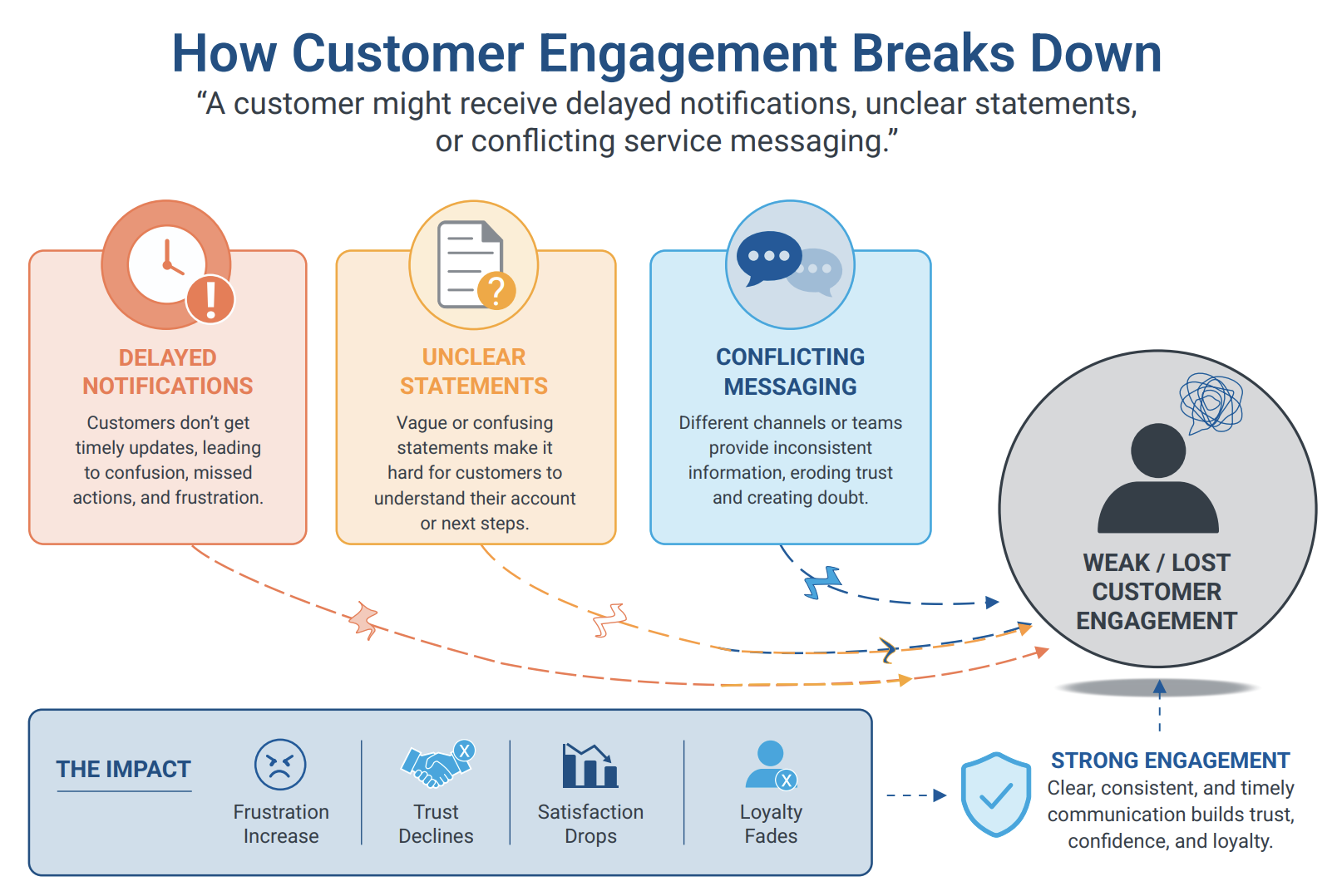
Customer engagement breaks down because the systems behind the experience aren’t fully integrated into the customer’s journey.
Customer data, servicing platforms, payment platforms, payment systems, and communication tools frequently operate in silos, with different teams managing different channels. As a result, updates take longer, messaging is inconsistent, and customers can end up receiving mixed signals depending on where and how they interact with the organization.
That disconnect creates friction throughout the experience.
A customer might receive delayed notifications, unclear statements, or conflicting service messaging. For new customers, especially, onboarding can feel fragmented instead of guided and seamless.
The problem becomes even more obvious when customers pivot between channels. For example, when a customer contacts support to resolve an issue, they may have to repeat information if they’re being transferred to a different department on a call. The lack of continuity, often caused by siloed systems and poor coordination across the organization, creates unnecessary frustration and slows down resolution.
Over time, these gaps can eat away at trust, one of the most important foundations in banking and financial services. Customers increasingly expect seamless communication that brings security through consistency across channels, and experiences that feel intuitive.
Organizations that deliver smoother digital experiences and stronger cross-channel engagement tend to see higher satisfaction and loyalty scores, while disconnected experiences create frustration and reduce confidence in the brand.
When communication is disconnected, the customer feels disconnected too.
A McKinsey survey of regulated sectors, including banking, shows that the quality, consistency, and availability of digital interactions play a major role in overall customer satisfaction.
Source: McKinsey & CompanyOperational Communications: Where Engagement Begins
In financial services, many of the most important interactions take place through operational communications — the everyday messages customers rely on to manage their accounts and finances.
These interactions include monthly statements, payment reminders, fraud alerts, and more. Customers pay attention to these messages because they’re directly connected to their money, security, and financial decisions.
For example, a fraud alert can help a customer act quickly and feel protected, while a clear onboarding package can ensure quicker activation of services, including credit cards and online banking. Even something as routine as a payment reminder can shape how customers perceive an organization.
Because these communications are so frequent and highly visible, they play a major role in the overall customer experience. When messages are timely and highly personalized, regardless of channel, they help strengthen trust and reduce friction. But when communication is delayed or unclear, institutions may see higher service inquiries and greater customer dissatisfaction.
How a CCM Platform Improves Customer Engagement
Consistency wins in customer engagement.
Kantar and Capgemini found that banks with stronger customer experiences see higher customer recommendation rates and greater cross-selling opportunities. As customer expectations continue to rise, a CCM platform can support organizations in their efforts to build trust, loyalty, and meaningful engagement. Here are five ways a CCM platform helps improve customer engagement.
Consistency and Transparency Across Channels
A customer may receive a statement by email, view their account details on a mobile app, and complete a payment online. Those experiences should feel interconnected and true to your voice.
A CCM platform helps financial institutions meet their strategic objectives by maintaining consistent messaging and branding across mediums.
Greater Personalization
Personalization in financial services reinforces communication that is relevant and timely. It strengthens the customer relationship by offering information that is accurate and useful.
A CCM platform allows institutions to tailor messages using customer preferences, account activity, and preferred channels.
Smoother Onboarding Experiences
Onboarding is one of the most important communication stages in the customer lifecycle, because a poor experience creates frustration early in the relationship. A CCM platform helps streamline onboarding by improving document delivery, workflow coordination, communication timing, and continuity.
Reduced Customer Effort
Customers want interactions with their financial institutions to feel easy and intuitive. That can't be achieved when operations are fragmented. A CCM platform unifies your systems and data to ensure better coordination between departments, reducing the need for repeat information, restarting conversations, and searching across channels for answers and missing important updates.
Improved Payment and Billing Experiences
Payment communications are some of the most important interactions in financial services.
A CCM platform improves customer experiences through easy-to-follow statements, timely reminders, and integrated digital payment journeys. This mitigates late or missed payments, lowers support inquiries, and reduces incomplete payments.
Interested in how Doxim helps financial institutions deliver a modern statement design?Check out our playbook, The Evolution of Print to Digital: 5 Key Stages to Modernize Your Statements and Transform Customer Engagement, to learn more!
From Fragmented to Unified
Here are three steps to transform your communication operations and customer experiences with a CCM platform:
1. Centralize Your Communications and Customer Data
The first step in implementing a CCM platform is bringing fragmented communications into a centralized environment. A modern platform will consolidate communications, workflows, customer preferences, and delivery preferences into a single platform while integrating with existing systems. This creates more consistency, stronger governance, and a single view of the customer.
2. Build Cohesive Omnichannel Customer Communications
Once communications and data are centralized, financial institutions can create more seamless, channel agnostic customer journeys. The goal is continuity, as customers should be able to distinguish your brand identity regardless of the platform or communication with which they’re interacting.
For example, a payment reminder delivered by SMS can direct a customer to a secure portal where they can review their statement and submit a payment. While using a mix of channels, the journey feels consistent and unified, and it has an immediate impact on the customer’s perception of your brand, in a positive way.
3. Scale Securely with Automation and AI
The final step is optimizing communication delivery through automation and AI-driven capabilities. Financial institutions are increasingly using AI to personalize messaging and automate routine tasks to improve efficiency and reduce errors.
Compliance and security are built into the process through audit trails and version control. With the right CCM strategy in place, financial institutions can improve operations while delivering more responsive and flexible customer-centered experiences.
Operational Impact
When communications are managed outside of a centralized platform, processes are often disconnected, generic, and difficult to manage.
A CCM platform creates a more efficient and controlled environment that allows marketing teams to act more strategically and plan for the future.
| Before CCM Platform Implementation | After CCM Platform Implementation |
|---|---|
| Disconnected systems | Centralized communication ecosystem |
| Template-heavy processes | Flexible, reusable content management |
| Difficult governance and oversight | Governed, trackable workflows |
| Inconsistent messaging across channels | Consistent omnichannel experiences |
Customer Experience Impact
The customer feels the benefits of unified communications almost instantly. Centralized communications allow for the delivery of personalized communications that are relevant, timely, and meet customers where they are.
| Before CCM Platform Implementation | After CCM Platform Implementation |
|---|---|
| Disconnected customer journeys | Connected experiences across channels |
| Unclear or confusing notices | Clear, easy-to-understand communication |
| Delayed updates and responses | Timely, proactive communication |
| Repetitive service interactions | Smoother self-service experiences |
| Inconsistent messaging | Reliable, coordinated engagement |
| Generic outreach | More relevant, personalized financial communications |
Turning Everyday Communications into Cohesive Customer Experiences
Customer engagement in financial services is increasingly defined by the quality of everyday interactions. Regulated customer communications, like statement servicing updates, are opportunities to build trust and establish customer relationships that are built to last.
A CCM platform enables financial institutions to deliver consistent and personalized communications throughout the customer lifecycle. By improving how information is shared and experienced, organizations can reduce friction while creating more meaningful connections.
Transform Your Financial Communications with Doxim CCM
Streamlined Billing Processes Centralize omnichannel communications through one comprehensive platform. Integrate print, mail, digital, and customer engagement for complete, omnichannel delivery.
Improve marketing effectiveness with targeted cross-sell and customer outreach campaigns.
Enjoy a comprehensive view of the customer journey with self-service administration, reporting, and an intuitive client portal.
FAQ
What is CCM in financial institutions?
How does a CCM platform improve customer engagement?
Why are statements and notices important for engagement?
How does a CCM platform support personalization in banking?
Can a CCM platform help reduce call center volume?
How does a CCM platform support compliance in financial services?
What channels should financial institutions use for customer communications?
How is a CCM platform different from a CRM system?
How can credit unions use a CCM platform to improve member engagement?
What metrics show whether a CCM platform is improving engagement?
- Digital adoption and open rates
- Payment completion
- Self-service usage such as FAQs
- Customer satisfaction scores