
Uncover the six ways to improve efficiency without compromising compliance.
Many organizations still manage customer communications through manual processes, disconnected systems, and channel-specific workflows.
Fragmentation can lead to delays, inconsistent content, and errors. Customer Communications Management (CCM) automation replaces manual work with controlled workflows that are easier to manage.
For regulated teams, the goal is to automate the right processes while maintaining the control needed to meet business and regulatory requirements.
What Is CCM Automation?
CCM automation uses customer communication management (CCM) software to streamline how customer communications are created, managed, and delivered.
In practice, CCM software provides the technology for automation, while a CCM platform brings the necessary data, workflows, and delivery functions together.
A CCM platform can take information from core business systems and use it to create communications such as statements, bills, notices, policy documents, letters, and service messages. Those communications can then be distributed through the customer’s preferred channels based on the organization’s rules and requirements.
This creates a controlled process from customer data to final delivery, rather than a collection of separate communication tasks.
Why Is CCM Automation Important for Enterprises?
Customer expectations have changed, but many internal communication processes have not.
Customers expect timely, relevant information through the channels they use. Internally, organizations need efficient workflows, strong controls, and clear visibility into what was sent and when.
Automation helps connect these requirements. Instead of repeatedly creating documents and moving them manually between teams, organizations can establish reusable templates and workflows. Approved content can be updated centrally and used consistently across large volumes of communications.
This becomes particularly valuable as an organization grows. Enterprise communication management requires more than sending messages quickly. It requires control over the information, technology, and people involved.
How Do Automated Document Generation Workflows Work?
Automated document generation workflows turn business data and predefined rules into finished customer communications.
Data may come from existing business systems. The CCM workflow then applies the appropriate template, content, customer information, and business rules. Approval or exception steps can be triggered before the communication is produced and delivered.
This reduces repetitive document creation, versioning, review, and distribution work.
The strongest workflows still allow human intervention where it matters. An unusual account condition, missing data, or high-risk communication may require review rather than automatic release.
How Does CCM Automation Improve Customer Experience?
Automation improves customer experience when it makes communications clearer, faster, more relevant, and easier to receive.
A customer should not get conflicting information simply because an organization uses different systems for its online portal, email, and print communications. Centralized content and connected workflows help maintain a consistent message while adapting to each channel.
Personalization can go further than adding a customer’s name. Relevant customer data and communication preferences can help determine what information to include and how to deliver it.
That makes personalized customer experience automation useful for both service and operational communications.
Where Does AI Fit into CCM Automation?
AI can add value to CCM automation by helping teams create relevant content and simplify complex information. Generative AI can create personalized, contextual content for communications such as statements and notices, while conversational AI can make complex information easier to navigate through interactive elements built directly into a communication.
In regulated environments, AI should work to establish CCM controls. Organizations should keep human oversight where a particular review or approval is built into the existing process and ensure AI-generated content is grounded in factual information.
How Can Regulated Organizations Automate Communication Safely?
Safe automation starts with governance. Financial services, insurance, healthcare, and utilities often handle communications where errors or unauthorized use of customer data can have consequences beyond a poor customer experience.
Automation should therefore include appropriate permissions, approval controls, version management, and auditability. Privacy and secure archiving should also be built into the process.
Accessibility is a key component in the process as well. Design and test digital communications so customers using assistive technologies can access important information. The World Wide Web Consortium (W3C)’s current Web Content Accessibility Guidelines (WCAG) resources provide a useful technical reference for accessible digital content and documents.
How Does CCM Automation Reduce Risk?
Manual communication processes make control difficult because important decisions can be spread across email threads, local files, spreadsheets, and individual employees.
CCM automation can put those decisions into defined workflows. Teams can establish who may change content, which changes require approval, which version is active, and what happens when data or delivery exceptions occur. This creates a stronger audit trail.
Rather than trying to reconstruct a communication after an issue occurs, authorized teams can retain evidence of the content, workflow, and delivery process.
Automation does not remove compliance responsibility. It makes established controls easier to apply consistently. For organizations sending U.S. financial communications, requirements can vary by communication type. Consumer Financial Protection Bureau (CFPB) regulations, for example, may also need to account for communication-specific requirements, including how certain disclosures and notices are delivered and presented.
What Systems Should a CCM Platform Integrate With?
The exact integration model depends on the organization, but a CCM platform generally needs access to the systems that contain the information required to produce and manage customer communications. That can include:
- CRM and customer service applications
- Billing or payment platforms
- Document archives
- Identity systems
- Industry-specific core systems
Integration should also work in both operational and reporting terms. Teams need visibility into what happened to a communication, including whether it was successfully generated or delivered or whether an exception occurred.
A useful test is simple. Can the communication workflow use reliable customer data without requiring employees to repeatedly copy it between systems?
How Do You Measure CCM Automation Success?
Measurement should cover both operational performance and customer outcomes.
Rather than tracking every available metric, focus on measures that show whether automation makes the process faster, more reliable, and less dependent on manual work. Reporting can also help organizations monitor communication success, engagement, and compliance activity.
The important point is to establish a baseline before automation. If statement production currently requires several manual reviews, for example, measure the processing time and error rate before changing the workflow. That gives the organization a meaningful comparison after implementation.
Customer feedback and service contacts can add another view. Faster production has limited value if customers still cannot understand the communication.
Learn how Doxim can help you automate your communications while maintaining control, consistency, and compliance.
What Is the Difference Between CCM Automation and General Marketing Automation?
Marketing automation primarily manages campaigns, leads, audience journeys, and promotional engagement. CCM automation has a broader operational role in managing service and transactional customer communications, including statements, bills, notices, and correspondence.
This distinction is important in regulated environments. A promotional email and a legally required account notice may use the same delivery channel, but each can carry very different obligations.
US CAN-SPAM guidance makes a similar distinction between commercial email and transactional or relationship messages, with different requirements depending on a message’s primary purpose.
What Are the Most Important CCM Automation Practices?
The most effective approach is to automate around governance rather than simply automating existing manual processes.
In practice, that means focusing on a few core principles. The goal is to improve the process itself rather than simply move an old process onto a new platform.
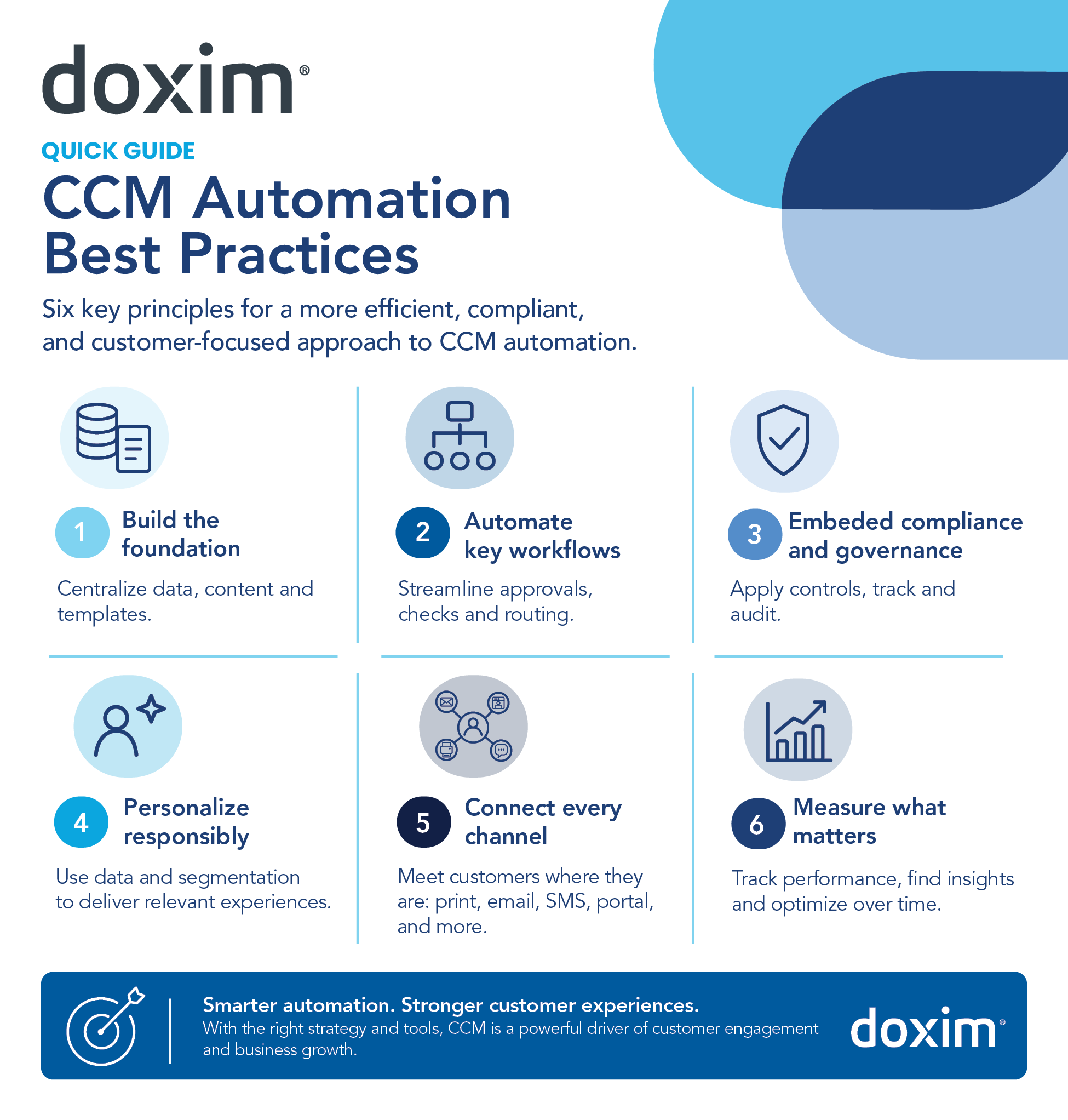
Build the Foundation
Before automating workflows, understand the communication process already in place. Review existing communications and identify where teams duplicate content, manually copy data, wait for approvals, or maintain different versions of the same message.
Centralized data, content, and updated templates provide a stronger foundation for automation. Approved content should have a clear source of truth, allowing teams to reuse existing materials rather than rebuilding communications for each channel.
Automate Key Workflows
Automation can reduce repetitive work and make document production more efficient. Workflows can manage approvals, checks, and routing while still allowing for human review when needed. This is especially important for exceptions or higher-risk communications that may require additional oversight before release.
Embed Compliance and Governance
Compliance and governance should be built into automated workflows from the start. Appropriate controls, approvals, and audit records help regulated organizations maintain oversight as they automate more processes.
When working with organizations in regulated industries, it’s a non-negotiable to consider accessibility, and secure data handling throughout the communication lifecycle.
Personalize Responsibly
Reliable customer data helps organizations make communications more relevant and useful. Personalization helps reflect customer information and references while still following established business and governance rules. Both help improve the customer experience without introducing unnecessary complexity or risk.
Connect Every Channel
Omnichannel delivery should make it easier to reach customers through the channels they choose while keeping communications consistent.
Customer preferences help guide delivery across digital and print channels. For regulated communications, those preferences must also be balanced with applicable consent and delivery requirements.
Measure What Matters
Establish a baseline before automating for a clear way to measure the impact. Focus on whether automation improves efficiency and reliability and use those results to identify opportunities for further improvement.
Customer outcomes matter too. Faster production has limited value if customers still struggle to understand or access their communications.
Building a Controlled Communications Foundation That Grows
Effective CCM automation is about more than reducing manual work. It creates consistent, controlled, and scalable way to manage customer communications.
Start with the right processes, integrate reliable data, build in governance, and keep measuring outcomes. With those practices in place, automation can improve efficiency without sacrificing the accuracy, compliance, and customer experiences that matter most.
Learn how Doxim uses automation to drive better results at scale.